
Planful, a leading cloud-based financial planning and analysis (FP&A) platform, empowers over 1,300 organizations in 2025 to streamline budgeting, forecasting, and reporting. Trusted by companies like Bose, 23andMe, and TGI Friday’s, AI-driven tools and integrations with Microsoft Dynamics, Sage Intacct, and NetSuite enhance financial agility for mid-market enterprises and remote teams. With features like scenario modeling and real-time analytics, it eliminates manual processes, enabling confident decision-making. This article explores Planful’s key features, recent advancements, and best practices for leveraging it in 2025’s dynamic financial landscape.

What Makes Planful Stand Out?
Planful is a comprehensive FP&A solution designed for finance teams, offering automation and collaboration. Its core strengths include:
- Automation: Streamlines budgeting, forecasting, and financial close processes.
- AI-Driven Insights: Native AI supports scenario analysis and predictive analytics.
- Cloud-Based Accessibility: Enables real-time collaboration for distributed teams.
- Integration: Connects with ERP systems like QuickBooks, NetSuite, and Microsoft Dynamics.
- Scalability: Suits mid-market firms with complex financial needs.
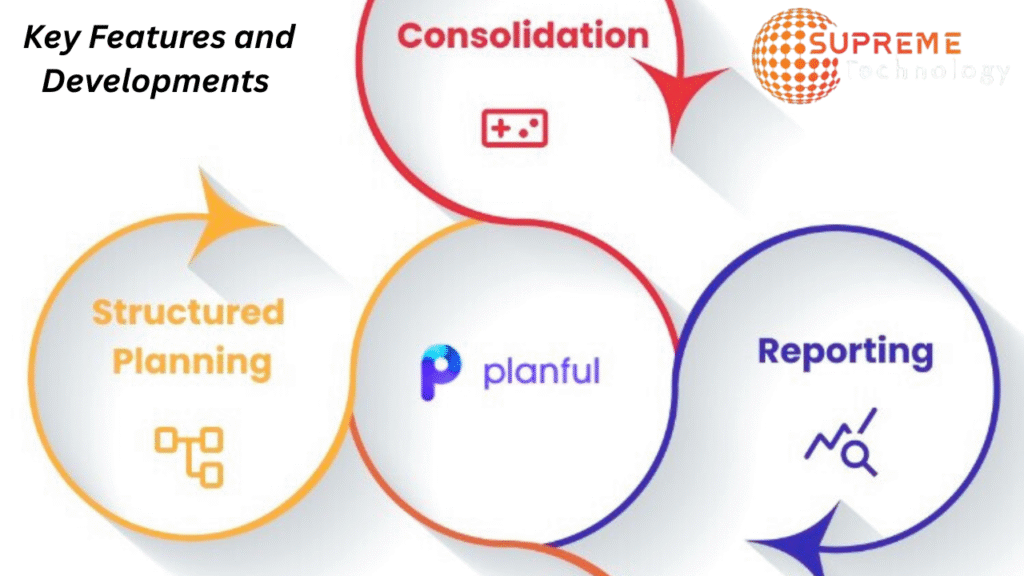
Key Features and Developments for Planful in 2025
Drawing from recent reviews and updates, here are the top advancements in Planful for 2025:
1. AI-Powered Scenario Modeling
- Description: Planful’s Predict AI, enhanced in 2025, offers flexible scenario modeling and what-if analyses, allowing users to adjust variables and forecast outcomes under varying economic conditions. It integrates real-time data for accurate predictions.
- Key Benefits: Enables agile planning; reduces manual forecasting errors.
- Best For: Finance teams needing to pivot quickly in volatile markets.
- Implementation: Use Predict in the dashboard to run scenarios; integrate with ERP for real-time data.
2. Streamlined Financial Close
- Description: Planful automates data consolidation and report generation, cutting financial close times significantly. Its 2025 updates include improved workflow management with version control and audit trails for accountability.
- Key Benefits: Saves time; enhances accuracy in month-end processes.
- Best For: Enterprises aiming to reduce close cycles.
- Implementation: Set up automated workflows in the platform; use templates for consistent reporting.
3. Microsoft Dynamics Integration
- Description: Planful’s integration with Microsoft Dynamics 365 F&O and Business Central, expanded in 2025, adds end-to-end FP&A capabilities. It supports financial and operational planning, consolidations, and analytics within Microsoft’s ecosystem.
- Key Benefits: Seamless data flow; enhances collaboration for Dynamics users.
- Best For: Businesses using Microsoft ERP solutions.
- Implementation: Connect Planful via AppSource; configure data sync with Dynamics.
4. Customizable Dashboards and Reporting
- Description: Planful’s 2025 platform offers customizable dashboards displaying key performance indicators (KPIs) and ad hoc analysis tools. Users can drill into transactional data and export reports to Excel for sharing.
- Key Benefits: Provides clear insights; supports cross-departmental collaboration.
- Best For: Finance and non-finance teams needing tailored reports.
- Implementation: Build custom reports in the web app; share via Google Drive or Excel.
5. Workforce Planning Enhancements
- Description: Planful’s workforce planning module, highlighted in a 2025 Valtech case study, aligns HR and finance for headcount and labor forecasting. It integrates with operational data to predict workloads accurately.
- Key Benefits: Improves budgeting for staffing; fosters HR-finance collaboration.
- Best For: Companies with complex workforce needs.
- Implementation: Use the Workforce Planning module; involve HR in setup for accurate data.
Warnings and Considerations
- Steep Learning Curve: The interface can be complex for new users, requiring training. Leverage Planful’s Solution Hub for tutorials.
- Customer Support Issues: While improved in 2025, past reviews noted slow response times. Plan for in-house expertise or consultant support.
- Customization Challenges: Advanced customizations may need technical skills or vendor services, increasing costs. Budget for professional services if needed.
- Performance with Large Datasets: Processing large datasets can slow performance. Optimize data inputs and consider cloud upgrades.
- Pricing Opacity: Planful offers custom quotes (starting at ~$1,250/month), which may be costly for smaller firms. Compare with alternatives like Cube or Vena.

How to Leverage Planful Effectively in 2025
Maximize your Planful experience with these strategies:
- Digital Nomads: Access Planful’s cloud platform remotely; use mobile-friendly dashboards for on-the-go insights.
- Finance Teams: Automate budgeting and close processes with pre-built templates; use Predict for scenario planning.
- Business Leaders: Deploy customizable reports to track KPIs; involve non-finance teams for collaborative planning.
- Startups: Start with core features to manage budgets; scale to advanced modules as needs grow.
- IT Admins: Integrate with ERP systems like NetSuite; work with implementation partners to ease onboarding.
Conclusion
In 2025, Planful remains a leading FP&A platform, empowering over 1,300 organizations with AI-driven tools, seamless integrations, and automated workflows. Its scenario modeling, financial close automation, and Microsoft Dynamics integration make it ideal for mid-market enterprises and remote teams. Despite challenges like a steep learning curve and potential performance issues with large datasets, Planful’s scalability and robust feature set drive financial agility. By leveraging its automation, customizing dashboards, and integrating with ERP systems, users can streamline planning and reporting to thrive in 2025’s location-independent financial ecosystem.